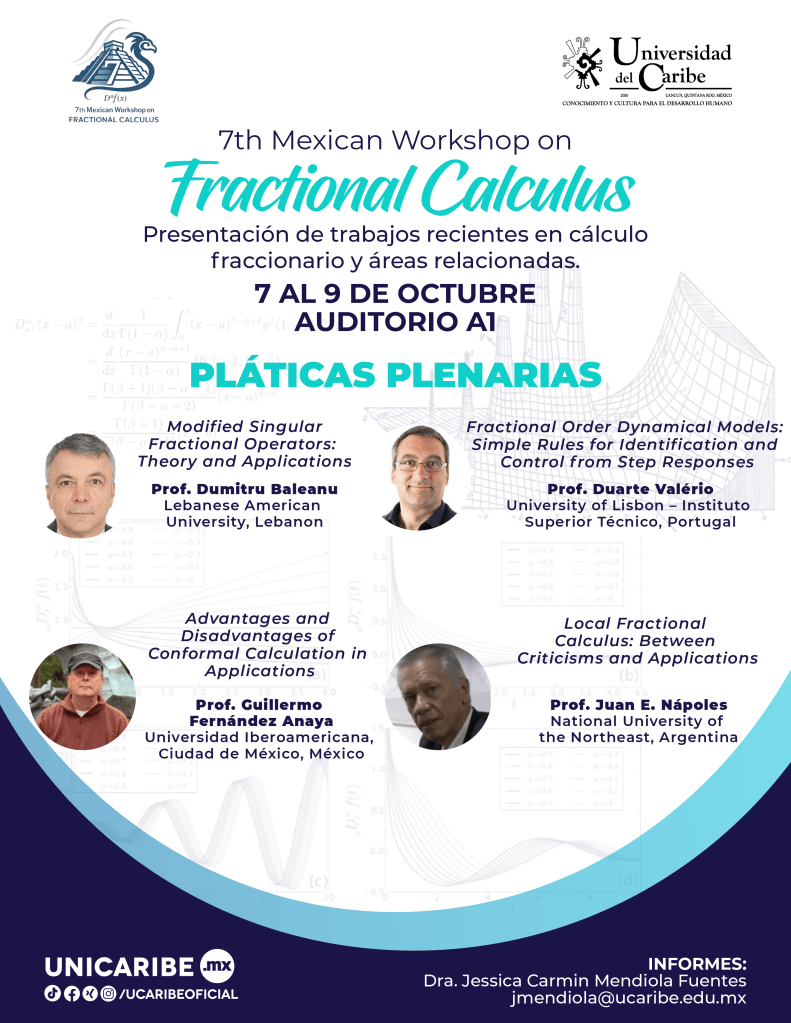
The scientific program of the 7th Mexican Workshop on Fractional Calculus (7th MWFC) will include plenary lectures by invited speakers and contributed talks covering theoretical developments, numerical methods, and applications of fractional calculus and related areas.
The workshop will be held in a hybrid format at Universidad del Caribe, Cancún, Mexico, from October 7 to 9, 2026.
Plenary Talks
Prof. Dumitru Baleanu
Department of Computer Science and Mathematics
Lebanese American University, Lebanon
Talk: Modified Singular Fractional Operators: Theory and Applications
Abstract: Fractional calculus denotes an extension of meaning. Thus, it deals with the study of fractional-order integral and derivative operators over real or complex domains and their applications. In this talk, new results concerning modified singular operators with Mittag-Leffler kernels will be presented. The geometrical meaning of some modified operators with Mittag-Leffler kernels will also be discussed, together with several illustrative real-world examples.
Prof. Duarte Valério
University of Lisbon
Instituto Superior Técnico, Portugal
Talk: Fractional Order Dynamical Models: Simple Rules for Identification and Control from Step Responses
Abstract: Fractional-order derivatives can be used to model and control dynamical systems, and there are several areas of science and engineering where they can be applied with advantage over models that only include integer-order derivatives. However, practical use of such models, particularly in industrial settings, depends on easy application. Identification procedures based on optimization algorithms may be cumbersome, while simple rules based on a system’s step response, often known as a reaction curve, provide a faster and simpler alternative.
This talk addresses rules based on the knowledge of a system’s step response to obtain fractional-order models and to design controllers for such models. First- and second-species transfer models, as well as PID and fractional PID controllers, will be considered. Results show that these rules can provide reasonable models and well-performing controllers even when experimental unit-step measurements are affected by Gaussian noise.
Prof. Guillermo Fernández Anaya
Department of Physics and Mathematics
Universidad Iberoamericana, Mexico City, Mexico
Talk: Advantages and Disadvantages of Conformal Calculation in Applications
Abstract: Conformal calculus, from its origins with Gateaux, Todorov, Khalil, and Zhao to its recent developments, has sparked a debate about its nature. Although the derivatives introduced by Khalil and Zhao are local operators that, under the appropriate definition, are equivalent to classical calculus via an invertible substitution, their value lies in their ability to provide alternative formulations.
Analogous to the Hamiltonian and Lagrangian representations in classical mechanics, the introduction of parameters in conformal calculus offers new analytical perspectives. Furthermore, the formalism allows for the construction of memory-carrying variants generated from the Khalil kernel that are not equivalent to classical calculus. This talk will discuss the relevance of the conformal derivative in practical applications, its connections to the fractal derivative, and the new theoretical alternatives it enables.
Prof. Juan E. Nápoles
Department of Mathematics
National University of the Northeast, Argentina
Talk: Local Fractional Calculus: Between Criticisms and Applications
Abstract: In this presentation, we provide an overview of Local Fractional Calculus, formalized in 2014 with the Conformable Derivative and now used in applications and simulations involving real-world problems. We first address some of the criticisms leveled against it and discuss its relationship with Classical and Global Fractional Calculus.
To illustrate the scope and versatility of this approach, we examine the (3+1)-dimensional nonlinear Korteweg-de Vries-Calogero-Bogoyavlenskii-Schiff (KdV-CBS) evolution equation using the METHFM method. Three dynamic scenarios governed by distinct kernels are analyzed, together with their application to different media. Finally, new research directions involving other local operators will be discussed.

